
For decades, the traditional approach to business growth has followed a relatively familiar path. An entrepreneur identifies an opportunity, establishes a company, assembles a team, develops a product or service, and gradually expands into new markets. Success is commonly measured through revenue, profitability, market share, geographic presence, and organizational size.
This model has created remarkable companies and transformed entire industries. It has allowed ambitious founders to turn individual ideas into substantial commercial organizations.
However, the business environment is changing. In an increasingly interconnected world, the limitations of operating independently are becoming more apparent. Even successful entrepreneurs can encounter boundaries in their access to relationships, intelligence, capital, opportunities, specialized expertise, and international markets.
A company may possess an exceptional product but lack the relationships required to introduce it into new territories. An established founder may have significant industry knowledge but remain disconnected from complementary capabilities in other sectors. An organization may achieve substantial growth while remaining dependent on a relatively narrow commercial environment.
These challenges introduce a different way of thinking about business development.
The question is no longer simply how to build a larger company. It is how to position an organization within a broader structure capable of creating opportunities beyond its individual boundaries.
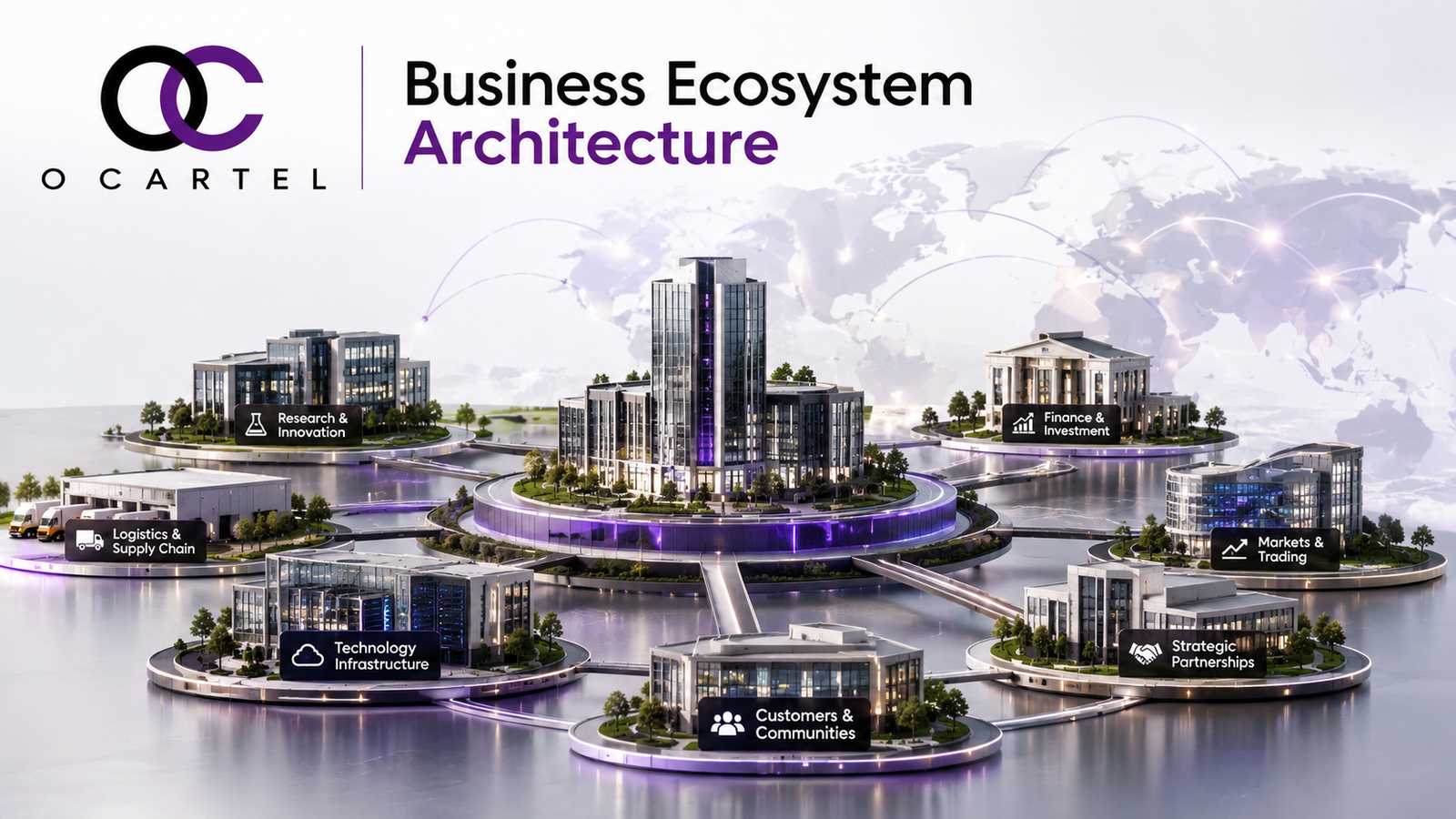
This is the thinking behind Business Ecosystem Architecture. Business Ecosystem Architecture considers how independent companies, people, resources, relationships, and territories can become strategically connected through a coordinated economic framework. It moves beyond conventional networking and isolated organizational expansion toward a more deliberate model of economic alignment.
For founders building substantial organizations, this represents an important shift in perspective: from developing individual businesses to participating in a wider economic structure.
At O CARTEL, this philosophy is expressed through Private Economic Architecture™, supported by HIPACHI, its underlying economic operating system.
Understanding Business Ecosystem Architecture
Business Ecosystem Architecture refers to the deliberate organization of independent businesses, individuals, resources, capabilities, and commercial relationships into a coordinated economic environment. Rather than viewing every company as an isolated organization, this approach considers how different businesses can contribute to a larger structure while maintaining their individual identities and specialized strengths.
Imagine several companies operating across different industries and geographical territories. One may specialize in technology, another in medicine, another in financial services, and another in international trade.
Individually, each organization possesses its own expertise, relationships, intellectual property, and market position. However, when their capabilities are strategically connected, opportunities can emerge that would be difficult to develop independently.
Knowledge can move between complementary organizations. Established relationships can introduce new commercial possibilities. Local market expertise can support international expansion. Specialized resources can become accessible through carefully structured relationships.
The objective is not simply to bring multiple businesses under one umbrella. It is to create meaningful coordination between them.
This distinction is fundamental. A collection of unrelated companies does not automatically constitute a functioning business ecosystem. Without strategic alignment, shared principles, appropriate governance, and a defined operating framework, multiple organizations may remain disconnected despite occupying the same commercial environment. Effective Business Ecosystem Architecture therefore begins with intentional design.
It considers which capabilities should be connected, how relationships should operate, where complementary opportunities exist, and how the overall structure can develop over time.
The result is a broader approach to business capability, where individual organizations can contribute to something larger without necessarily surrendering their independence.
Why Building a Business in Isolation Creates Structural Limitations
An independent company can develop extraordinary capabilities. It can establish a respected brand, recruit experienced professionals, build proprietary technology, develop intellectual property, and achieve a strong position within its industry. Yet every independent organization operates within certain structural boundaries.
Its relationships are influenced by its existing network. Its commercial opportunities depend partly on the markets it can access. Its intelligence is shaped by the information available to its leadership. Its ability to expand is influenced by the resources and relationships it can independently establish.
These limitations do not necessarily indicate poor management or insufficient ambition. They are often consequences of operating within a restricted organizational environment.
Consider an established company seeking to enter an unfamiliar international market. It may possess a competitive product, experienced management, and sufficient operational capacity. However, it may lack local relationships, regulatory understanding, distribution partners, or knowledge of the territory's commercial environment. The company is capable, but its capabilities are not automatically transferable into a different market.
Similarly, a founder may have deep expertise in one industry but limited access to complementary knowledge in another. An opportunity may exist, but recognizing and developing it requires relationships beyond the founder's immediate professional environment. This is where Business Ecosystem Architecture becomes relevant.
Instead of expecting every company to independently develop every necessary capability, an interconnected economic structure considers how existing strengths can complement one another. The objective is not to eliminate independent businesses. It is to reduce unnecessary isolation.
A company can remain specialized while becoming more strategically connected. A founder can preserve an organization's identity while gaining access to a wider environment of knowledge, relationships, and opportunities. This introduces a more expansive understanding of business development: individual excellence remains important, but coordinated capability can create additional possibilities.
Economic Architecture: The Foundation of a Connected Business Environment
Business Ecosystem Architecture is closely connected to the broader concept of Economic Architecture. Economic Architecture refers to the deliberate organization of businesses, people, resources, relationships, and opportunities into a coordinated economic structure. It considers the larger environment within which individual organizations operate.
Traditional business planning often concentrates on the internal structure of a company. Leadership focuses on departments, employees, operations, products, customers, and financial performance. Economic Architecture introduces another dimension.
It considers how the organization relates to other businesses, markets, industries, territories, and economic participants. The difference is important.
A company may have an efficient internal operating model while remaining disconnected from valuable external capabilities. An organization may possess excellent management but lack the relationships required to participate in opportunities developing elsewhere. Economic Architecture considers these external dimensions as part of a wider strategic framework.
Within this framework, Business Ecosystem Architecture focuses on the relationships and connections between participating organizations and their capabilities. One concept establishes the broader economic structure. The other considers how the different elements operate within it.
Together, they introduce a different perspective on commercial positioning.For founders, this means considering more than the immediate performance of an individual company. It means evaluating how the organization can participate in a larger economic environment and how its existing strengths may become more valuable through strategic alignment.
From Traditional Scale to Strategic Density
For many years, business growth has been associated with organizational expansion. More employees. More customers. More products. More locations. More revenue. These measurements remain important indicators of commercial performance. However, they do not describe every dimension of business capability. A company can become larger without becoming more strategically connected.
It can open offices in multiple countries without developing meaningful local relationships. It can increase its workforce without gaining access to complementary expertise. It can expand its product portfolio without improving its position within the wider commercial environment.
This introduces the concept of Strategic Density. Strategic density describes the concentration of complementary capabilities, relationships, intelligence, resources, and opportunities within a coordinated business structure.
Its value is determined not simply by how many companies participate, but by the relevance and quality of their connections.
For example, consider a specialized technology company connected to experienced international operators, complementary service providers, established commercial relationships, and organizations with access to relevant markets.
These connections may provide opportunities to explore new applications, partnerships, distribution channels, and territories. The value emerges from the interaction between capabilities. This is different from conventional expansion.
Traditional scale measures how much an individual company has grown. Strategic density considers how much additional capability can become available through meaningful economic connections. For ambitious founders, this distinction changes the way growth can be evaluated.
Instead of asking only how many markets a company can enter independently, leadership can consider which strategic relationships may improve its ability to operate within those markets. Instead of measuring opportunity exclusively through internal resources, it can consider the complementary capabilities available within a wider structure.
The objective is not expansion for its own sake. It is to develop a more capable economic instrument.
HIPACHI: The Operating Architecture Beneath O CARTEL
At the center of O CARTEL's philosophy is HIPACHI, described as its underlying economic operating system. HIPACHI represents the architecture connecting selected people, companies, and territories within one coordinated economic structure. Its philosophy begins with an important distinction: bringing businesses together is not the same as strategically aligning them.
Companies can attend the same events, participate in the same professional networks, and establish relationships without developing meaningful economic coordination.
An operating architecture seeks something more deliberate. It considers how different organizations can maintain their individual strengths while participating in a broader framework.
Within O CARTEL's stated model, companies are established as American entities, intellectual property is centralized, and the broader platform operates as one coordinated architecture. These structural elements reflect an approach in which participating organizations are not viewed exclusively as independent commercial destinations.
Instead, they are considered components of a wider economic environment. The principle is alignment without eliminating individual strength.
HIPACHI provides the conceptual foundation for this approach. It connects the idea of individual organizational capability with the ambition of creating a more coordinated economic structure. This is an important distinction for founders who have already established successful businesses.
The objective is not necessarily to replace an existing company, reorganize its entire operation, or eliminate its commercial identity.
It is to consider how that company can participate in a wider architecture where relevant relationships, capabilities, and opportunities may become more accessible. Through HIPACHI, O CARTEL presentsBusiness Ecosystem Architecture as an operating philosophy rather than simply another networking concept.
Building Generational Companies Through Long-Term Architecture
Building a successful company and building a generational company are different ambitions. A successful organization may achieve strong financial performance, establish a respected reputation, and become a recognized participant in its industry. A generational company is built with a considerably longer horizon.
Its founders consider what the organization can become beyond its initial leadership. They think about how intellectual property can develop, how institutional knowledge can be preserved, how relationships can endure, and how the company can remain relevant as industries and markets evolve. This requires a different approach to strategic planning.
Short-term commercial opportunities must be considered alongside long-term positioning. Leadership must think about succession, institutional continuity, organizational resilience, and the ability to adapt across generations.
Intellectual property becomes an important consideration because proprietary knowledge, technology, processes, and creative assets may contribute to an organization's long-term identity and value. Strategic relationships also become important.
A company that develops meaningful relationships with complementary organizations may establish a broader foundation for future opportunities. This is where Business Ecosystem Architecture connects with the ambition of building generational companies.
A generational company does not need to think exclusively within the boundaries of its current operations. It can consider how its capabilities may contribute to a larger economic environment and how its relationships may remain relevant over time. O CARTEL's positioning is directed toward founders and Super Niche CEOs who are already building something of substance and recognize that the next level of capability may require a broader economic structure.
The ambition extends beyond creating a business that performs well today. It is about establishing an organization with the potential to maintain relevance, preserve its identity, and create value over an extended period.
Why International Business Expansion Requires Local Strength
International expansion is often described as entering new countries, opening offices, and acquiring customers in unfamiliar markets. However, geographic presence alone does not create meaningful international capability.
Every market operates within its own commercial environment. Business relationships, institutional structures, regulatory requirements, customer expectations, and local operating conditions can differ significantly between territories.
A company entering a new market without understanding these conditions may discover that geographic expansion does not automatically translate into meaningful commercial opportunities.
Successful international business expansion requires more than a physical presence. It requires local knowledge, relevant relationships, operational experience, and an understanding of the market's commercial environment.
A coordinated international business architecture approaches this challenge differently. It considers how local operators, specialized companies, and regional knowledge can contribute to a broader economic structure.
Local strength remains essential. Different territories bring different capabilities, relationships, expertise, and commercial perspectives. These strengths should not necessarily be replaced by a centralized structure.
Instead, they can become complementary elements within a wider architecture. O CARTEL expresses this ambition through the idea of a thousand cities operating as one coordinated instrument.
Its vision extends across multiple industries and domains, including medicine, law, environmental initiatives, art, music, stock exchanges, chambers of commerce, and news. The underlying philosophy is that individual strengths can become more accessible when connected through a deliberate economic structure.
This is not simply a question of geographic expansion. It is a question of how different territories can participate in a connected economic environment while maintaining their local relevance.
The Human Architecture: Why the Right Relationships Matter
Business Ecosystem Architecture is not exclusively about companies, ownership structures, intellectual property, or international operations. It is also about people. Many commercial opportunities begin with relationships between individuals who possess complementary knowledge, experience, resources, and ambitions.
A founder may understand an industry exceptionally well but lack international operating experience. An established business owner may possess strong market relationships but require specialized technical expertise. An experienced operator may recognize an opportunity but need the right commercial partner to develop it. In each situation, the potential value comes from the connection between different capabilities.
However, meaningful relationships are not created simply by bringing large numbers of people together. The composition of the room matters.
A gathering may include hundreds of participants without producing a single strategically relevant relationship. Conversely, a carefully composed group of individuals with complementary experience may create opportunities through a small number of meaningful introductions. This is reflected in O CARTEL's philosophy of composing rooms rather than filling them.
The principle is straightforward: meaningful introductions should be intentional. A founder should not simply meet more people. The founder should have the opportunity to connect with people whose capabilities, experience, or commercial position may be relevant to a broader objective.
This introduces the concept of human architecture. Within a coordinated business ecosystem, people are not merely participants in a network. They represent knowledge, operational experience, relationships, and the ability to develop opportunities.
The quality of these connections can influence the overall strength of the economic structure. For this reason, selectivity becomes an important part of O CARTEL's stated philosophy.
One Founder-Operator Seat Per Country
One of the defining elements of O CARTEL's stated model is its Founder-Operator structure. The platform describes one Founder-Operator seat per country. This approach is based on deliberate scarcity and territorial representation. Rather than dividing a country's position among multiple competing operators, O CARTEL presents the seat as exclusive to one selected operator.
The concept places importance on responsibility, representation, and the ability to participate within a wider international architecture. The Founder-Operator is not simply a participant in a conventional professional network. The position is intended to represent a country's place within the broader economic structure.
This introduces another dimension to international business architecture. A country is not merely a geographic destination. It represents a distinct commercial environment with its own industries, businesses, relationships, and local knowledge. A Founder-Operator who understands that environment may contribute important regional insight to the wider structure.
This approach also reflects O CARTEL's emphasis on selective participation rather than unrestricted membership. The intention is to establish a framework in which representation is deliberate and the composition of the overall structure remains strategically considered.
For founders with international ambitions, the concept introduces a different way to think about territorial participation. Instead of treating every country as another location to enter independently, the architecture considers how local representation may contribute to a coordinated international economic environment.
Cartel Republic: The Idea of a Shared Economic World
O CARTEL introduces another important concept through Cartel Republic.Its philosophy is built around the idea that an individual's standing should not be limited to a single company, market, or commercial environment. Instead, that standing can become relevant across a wider economic architecture.
A relationship established through one organization may become valuable in another. Experience gained in one market may contribute to opportunities in a different territory. Access to one part of the structure may create possibilities elsewhere. The ambition is to move beyond isolated commercial relationships toward a connected economic world. This idea can be understood through the expression:
One seat. An entire economic world.
The concept emphasizes the potential value of participation within a wider structure. A founder's contribution may extend beyond the immediate boundaries of an individual organization. Their expertise, experience, and relationships may become relevant to other parts of the architecture.
Cartel Republic represents this broader philosophical ambition. It considers how commercial standing, strategic relationships, and participation can operate within a connected environment rather than remaining restricted to separate organizational boundaries. For O CARTEL, this concept is part of a larger vision in which selected founders, companies, and territories participate in a coordinated economic structure.
Strategic Business Infrastructure: What Makes an Ecosystem Work?
A business ecosystem requires more than relationships and participation. It needs an underlying structure capable of supporting coordination. This is where Strategic Business Infrastructure becomes important. Strategic Business Infrastructure refers to the organizational, relational, intellectual, and operational foundations that support the development of a broader commercial environment. Several elements contribute to this foundation.
Strategic alignment
Participating organizations need a clear understanding of the broader objectives of the structure. Alignment does not require every company to operate identically, but it does require clarity about how different capabilities contribute to the wider environment.
Intellectual property positioning
Intellectual property can represent an important source of organizational value. Technology, proprietary processes, creative assets, and specialized knowledge require appropriate ownership, protection, and management arrangements. Within O CARTEL's stated model, centralized intellectual property is one of the structural principles associated with its wider architecture.
Relationship development
Business relationships should have strategic relevance. The objective is to establish connections that can support knowledge exchange, commercial introductions, complementary expertise, and opportunities for collaboration.
Territorial representation
International structures require an understanding of the territories in which participating organizations operate. Local knowledge and relationships can contribute to more informed commercial positioning.
Governance and accountability
A coordinated structure needs clear expectations, responsibilities, and appropriate decision-making processes. Governance helps define how participation works and how the interests of different organizations are considered.
These elements help distinguish a deliberately designed business ecosystem from an informal collection of commercial relationships. Strategic Business Infrastructure provides the foundation through which coordination can become more intentional and sustainable.
The Difference Between Business Networking and Business Ecosystem Architecture
Business networking and Business Ecosystem Architecture are related concepts, but they are not interchangeable. Traditional networking generally focuses on developing professional relationships.
Individuals attend events, exchange information, establish contacts, and explore possible commercial opportunities. These activities can be valuable. Relationships often begin through introductions and professional interactions.
However, networking alone does not necessarily establish a coordinated economic structure. Business Ecosystem Architecture introduces a broader perspective. It considers how companies, individuals, intellectual property, territories, and commercial capabilities can become connected through an underlying framework.
The distinction can be understood through several dimensions. Traditional networking emphasizes introductions. Business Ecosystem Architecture emphasizes strategic relationships.
Traditional networking often measures participation through the size of a network. Business Ecosystem Architecture considers the relevance and quality of connections.
Traditional networking may create individual opportunities. Business Ecosystem Architecture considers how capabilities can complement one another across a wider structure. Traditional networking is generally relationship-oriented. Business Ecosystem Architecture is both relationship-oriented and structurally designed.
This does not make networking irrelevant. It means that relationships can become more strategically valuable when they operate within a deliberate economic framework.
For founders seeking more than conventional networking opportunities, this distinction is important. The objective is not simply to know more people. It is to become meaningfully connected to an environment where relationships, capabilities, and opportunities can interact.
Who Benefits From a Coordinated Business Ecosystem?
Business Ecosystem Architecture is not necessarily relevant to every business at every stage of development. A newly established company may need to concentrate primarily on validating its product, acquiring customers, developing its operations, and establishing financial stability.A more established organization may begin facing a different set of questions.
How can the business access new markets? Which complementary capabilities could improve its commercial position? How can its intellectual property develop over time? What relationships may become relevant to its next stage of growth? These questions are particularly relevant to several categories of business leaders.
Established founders
Entrepreneurs who have already built functioning organizations may recognize that their next stage of development requires access to capabilities beyond their immediate companies.
Super Niche CEOs
Leaders of specialized businesses often possess deep expertise within a particular industry or market. Their capabilities may become more valuable through connections with complementary organizations.
International business operators
Entrepreneurs operating across territories may benefit from relationships with experienced local operators and organizations that understand different commercial environments.
Owners of generational businesses
Founders thinking beyond immediate financial performance may be interested in institutional continuity, intellectual property, long-term relationships, and the preservation of organizational value.
Specialized industry leaders
Businesses operating in fields such as medicine, law, technology, finance, environmental initiatives, art, and international commerce may possess capabilities that complement those of organizations in other domains. The common characteristic is not company size alone. It is the recognition that an organization's future capabilities may depend partly on its position within a wider economic environment.
Measuring the Strength of a Business Ecosystem
Traditional business performance can be evaluated through established financial and operational indicators. Revenue, profitability, customer retention, productivity, and market position remain important.
However, a coordinated business ecosystem requires additional ways of understanding its development. These measures should reflect the quality and relevance of its connections rather than simply counting participants. Several dimensions can help evaluate its strategic development.
Relationship relevance: Are the relationships within the structure aligned with meaningful commercial objectives?
Complementary capabilities: Do participating organizations bring expertise and resources that contribute to one another's capabilities?
Territorial knowledge: Does the structure provide meaningful understanding of the markets and territories in which it operates?
Opportunity development: Are relationships creating relevant introductions, partnerships, or opportunities for collaboration?
Institutional continuity: Is knowledge being preserved in ways that support long-term organizational development?
Strategic alignment: Do participating organizations understand how their individual strengths relate to the broader architecture?
These dimensions provide a more complete perspective on economic coordination. A larger network is not necessarily a stronger ecosystem. A greater number of participating companies does not automatically create more value. The central consideration is whether the connections are meaningful, appropriately structured, and relevant to the wider objectives.
This returns to the concept of strategic density. The strength of an ecosystem is influenced by the quality of its architecture and the complementary capabilities operating within it.
The Future of Business Belongs to Connected Economic Structures
The next generation of ambitious business leaders will need to think about more than the performance of individual organizations.
They will need to consider how businesses interact, how intellectual property is positioned, how relationships develop, how territories connect, and how economic capabilities can be coordinated over time. Traditional company growth will remain important.
Organizations will continue to develop products, recruit talent, enter markets, and pursue commercial opportunities. However, the boundaries of individual companies do not necessarily define the full extent of their potential.
A business can maintain its identity while becoming part of a wider structure. A founder can preserve the independence of an organization while developing relationships that extend beyond its immediate commercial environment.
This is the thinking behind Business Ecosystem Architecture. It represents a shift from isolated organizational growth toward coordinated economic capability.
For O CARTEL, this philosophy is expressed through a Private Economic Architecture™ built around selected founders, companies, operators, and territories.
Through HIPACHI, its underlying economic operating system, O CARTEL seeks to connect individual strengths within a broader economic structure.
Its ambition is directed toward generational companies, lasting influence, and permanent standing. The central philosophy can be expressed in one sentence:
Alone, you operate. Together, you alter the field.
Because the ultimate objective is not simply to become larger. It is to become more strategically connected.
Density becomes Destiny.
About O CARTEL
O CARTEL is a Private Economic Architecture™ built for generational companies, lasting influence, and permanent standing.
Through HIPACHI, its underlying economic operating system, O CARTEL seeks to connect selected people, companies, and territories within a coordinated economic structure.
Its philosophy is centered on strategic alignment, selective participation, international relationships, and the development of a connected economic environment.
O CARTEL operates by invitation.
O CARTEL™ | A Private Economic Architecture
Responses
No public responses yet.
Leave a response