
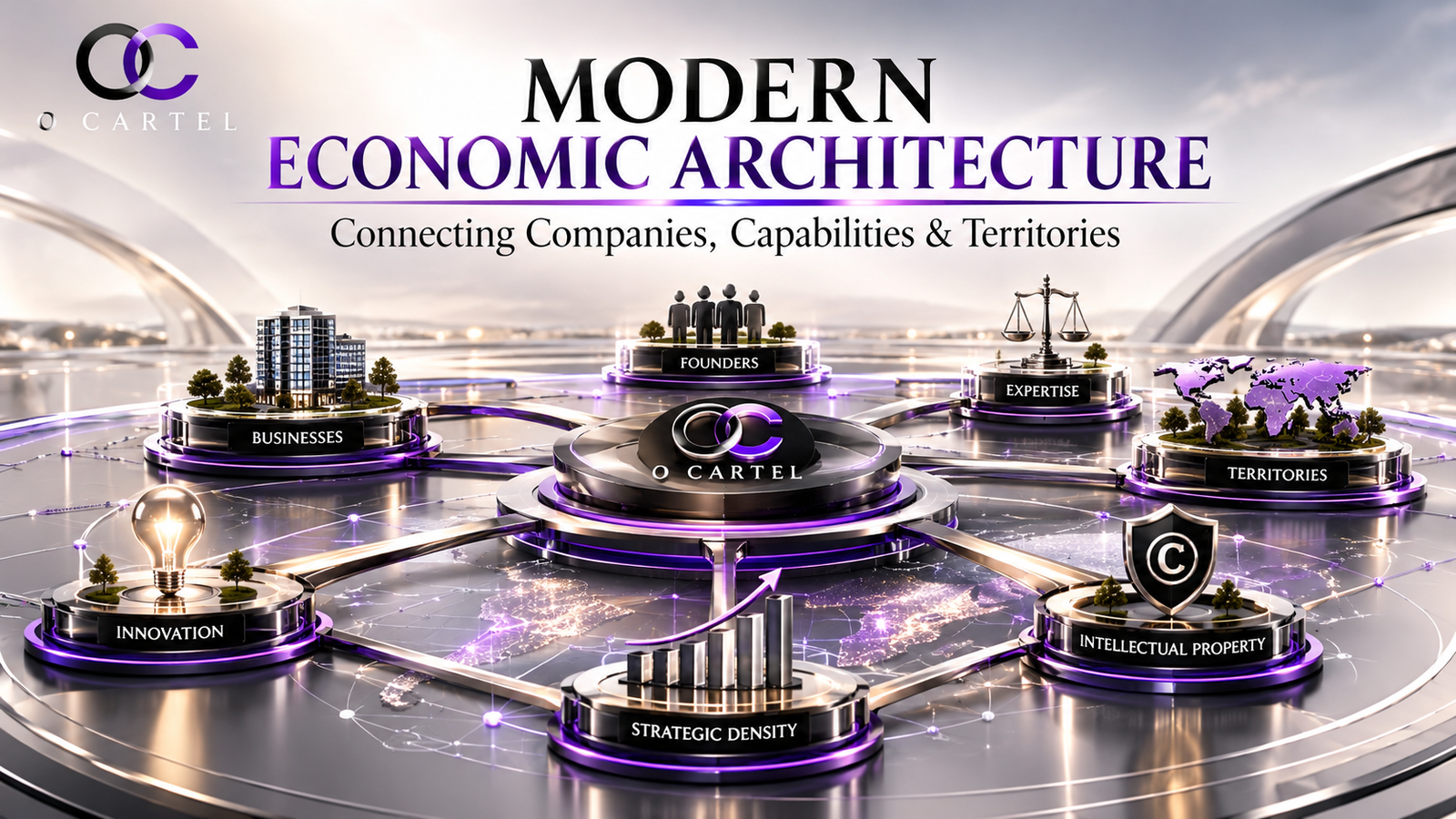
The Evolution of Modern Business Structures
For generations, the traditional understanding of business success has revolved around the development of individual companies. An entrepreneur identifies an opportunity, establishes an organization, develops a product or service, builds a team, and gradually expands into new markets. Growth is measured through revenue, profitability, market share, organizational size, and geographic reach.
This approach has created extraordinary businesses. It has transformed industries, generated employment, introduced new technologies, and enabled entrepreneurs to build organizations with international recognition. However, the structure of the global economy is changing.
Businesses increasingly operate in environments where relationships, intelligence, intellectual property, international access, and strategic coordination can be just as important as the resources held within an individual organization.
Even highly successful companies encounter structural limitations. Their commercial relationships may remain concentrated within particular industries. Their access to international opportunities may depend on a limited number of individuals. Their intellectual property may exist across disconnected entities. Their understanding of other markets may be restricted by geography and available relationships.
These limitations introduce a broader question. What happens when a company becomes part of something larger than itself? This question sits at the center of Modern Economic Architecture. Rather than considering a company as an isolated commercial organization, modern economic architecture examines how businesses, people, resources, intellectual property, and territories can operate within a coordinated structure.
The ambition moves beyond building larger companies. It becomes the development of more strategically connected economic capabilities. For founders building businesses with long-term ambitions, this represents an important evolution in how organizations can be positioned, coordinated, and developed.
At O CARTEL, this philosophy is expressed through the concept of a Private Economic Architecture™, supported by HIPACHI, its underlying economic operating system. The central idea is simple: individual strength becomes more meaningful when it is strategically connected to complementary capabilities.
Understanding Modern Economic Architecture
Modern Economic Architecture refers to the deliberate organization of businesses, individuals, resources, relationships, and opportunities into a coordinated economic framework. It examines the relationships between different commercial participants rather than focusing exclusively on the performance of individual companies.
In a traditional business structure, each organization generally develops its own operational capabilities, commercial relationships, market intelligence, and growth opportunities. Although companies may cooperate through partnerships, supplier agreements, or professional networks, these relationships do not necessarily form a coordinated economic system.
Modern economic architecture introduces a different perspective. It considers how multiple organizations can retain their individual identities while participating in a broader structure designed around strategic alignment. Imagine several specialized companies operating across different industries and international territories.
One organization may possess deep expertise in medicine. Another may operate within technology. A third may have established commercial relationships across financial markets. Another may understand regional distribution, legal environments, or international trade.
Individually, each organization possesses a particular capability. Within a coordinated economic structure, these capabilities may become complementary. Knowledge can move between participants. Relationships can introduce new opportunities. Regional expertise can support international development. Intellectual property can be positioned within a broader framework.
The value does not necessarily come from combining ownership of every organization. It comes from developing meaningful coordination between otherwise independent capabilities.
This distinction separates modern economic architecture from conventional business expansion. It is not simply about accumulating companies. It is about establishing a structure in which different organizations can contribute to a wider economic objective.
Why Traditional Business Structures Are Reaching Their Limits
Traditional business development generally follows a linear pattern. A company establishes its market position, builds its internal resources, develops commercial relationships, and gradually expands its operations. The model remains relevant, but it does not address every challenge facing ambitious modern businesses.
An organization may have excellent products but limited access to international distribution. A founder may have substantial industry experience but lack relationships with operators in complementary markets. A company may possess valuable intellectual property but lack an overarching strategy for developing and positioning those assets over time.
A business may enter a new country but struggle to understand its commercial environment, local relationships, and institutional structures. These are not necessarily operational failures. They often reflect the boundaries of an isolated business model.
The limitations of individual capability
Every company operates within a particular organizational perimeter. Its employees possess certain expertise. Its leadership maintains a specific network. Its commercial activities concentrate on selected markets. Its intelligence depends on available information and relationships.
Even when an organization performs exceptionally well, it cannot independently possess every capability required to navigate an increasingly interconnected world. The solution is not necessarily to expand every internal department or establish a presence in every market.
In some circumstances, a more effective approach is to develop relationships with complementary organizations and position them within a coordinated strategic framework.
The limitations of conventional networking
Business networking has traditionally focused on introductions, meetings, conferences, and professional relationships. These activities can be valuable, but access to people does not automatically create economic coordination. A large network may contain thousands of contacts without providing a meaningful operating structure.
Modern economic architecture considers a different question:
How can relationships become strategically useful beyond the initial introduction?
This requires selectivity, alignment, shared understanding, and a broader perspective on how different participants may contribute to one another.
The limitations of geographic expansion
Entering a new territory does not automatically establish international capability. A company may open an office in another country without developing meaningful local relationships or understanding the commercial environment. Geographic presence is only one element of international business development. Local intelligence, experienced operators, cultural understanding, commercial relationships, and regional knowledge remain important. Modern economic architecture seeks to connect these local strengths with broader international capabilities.
From Individual Companies to Coordinated Economic Systems
One of the defining characteristics of modern economic architecture is the transition from isolated organizations toward coordinated economic systems. A coordinated system is not simply a collection of businesses operating under similar branding. It requires a meaningful framework through which participants can understand their roles, relationships, responsibilities, and potential areas of cooperation.
Consider the difference between two business environments. In the first environment, several companies operate independently. They may share an industry, attend similar events, or occasionally exchange referrals. Their relationships remain informal and largely dependent on individual circumstances.
In the second environment, selected organizations participate in a broader architecture. Their capabilities are understood in relation to one another. Their relationships are developed intentionally. Their areas of expertise can complement different parts of the structure. Their participation follows a common strategic philosophy. The second environment has the potential to create greater strategic connectivity.
This does not mean that every company must share the same management, operations, or commercial identity. Individual organizations can preserve their independence while participating in a larger framework. The objective is alignment without eliminating individual strength.
The importance of structural coordination
Effective coordination requires clarity. Participants need to understand what the architecture is designed to achieve, how relationships are developed, what information can be shared, and where responsibilities begin and end.
Depending on the structure, coordination may involve:
- Strategic introductions between selected founders and operators.
- Relationships between complementary companies.
- Shared access to relevant commercial intelligence.
- International market relationships.
- Intellectual property positioning.
- Cross-industry collaboration.
- Long-term institutional relationships.
- Defined territorial representation.
These elements can contribute to a broader economic structure when supported by appropriate governance and clearly established operating arrangements. The architecture becomes meaningful through the quality of its relationships and the consistency of its underlying framework.
Strategic Density: The New Dimension of Business Capability
Traditional business growth emphasizes scale. More employees, more locations, more customers, more products, and more revenue are commonly used to evaluate organizational development.
These measurements remain important. However, they do not explain every dimension of economic capability. A company can increase its size without significantly improving its strategic position.
It can expand into several countries without developing meaningful relationships in those markets. It can increase its revenue without gaining access to complementary knowledge or resources.
This introduces the concept of Strategic Density. Strategic Density describes the concentration of complementary capabilities, relationships, intelligence, and opportunities within a coordinated economic structure.
It is concerned with the quality of connections rather than simply the number of participants. A specialized company connected to the right international operators, industry relationships, and complementary organizations may develop access to capabilities that would otherwise require considerable time and resources to establish independently.
Strategic density also introduces a different way to evaluate business relationships. Instead of asking how many contacts an organization has, leadership can consider the strategic relevance of those relationships.
Instead of measuring international presence exclusively through the number of offices, businesses can examine the quality of their local relationships and regional knowledge.
Instead of focusing only on the number of companies within a structure, attention can be directed toward the capabilities those organizations contribute. The distinction is important. A highly connected economic structure is not necessarily the largest one. Its value depends on whether its participants have meaningful reasons to remain connected and whether those connections support legitimate opportunities.
At O CARTEL, this philosophy is expressed through the principle:
Density becomes Destiny.
HIPACHI: The Economic Operating System Behind O CARTEL
Modern economic architecture requires more than a general philosophy.
It requires an underlying operating framework capable of connecting different participants within a coordinated structure.
At the center of O CARTEL's model is HIPACHI, described as its underlying economic operating system.
HIPACHI represents the architecture through which selected people, companies, and territories are intended to connect within a wider economic environment.
The distinction between a network and an operating system is important.
A network primarily establishes connections.
An operating architecture considers how those connections relate to one another and how they can contribute to a broader structure.
Businesses can attend the same meetings, share introductions, and participate in professional communities without developing meaningful strategic alignment.
HIPACHI reflects a more deliberate philosophy.
It considers how different companies can maintain their specialized strengths while participating in a wider economic architecture.
Within O CARTEL's stated model, companies are established as American entities, intellectual property is centralized, and the broader platform operates through one coordinated architecture.
These elements form part of the organization's stated approach to structuring its economic environment.
Alignment without eliminating independence
The objective is not to make every participating company identical.
Different businesses have different industries, capabilities, management structures, and commercial objectives.
Their individual identities remain important.
The broader architecture is intended to create strategic relationships between these capabilities without removing the strengths that make each organization valuable.
This is particularly relevant for founders who have already developed specialized companies and do not necessarily want to abandon their existing operational identity.
They may instead recognize that their next stage of development requires access to a wider economic environment.
HIPACHI represents O CARTEL's approach to connecting these dimensions.
For a deeper understanding, readers can explore our dedicated article on the Economic Operating System and the role of HIPACHI within O CARTEL's broader philosophy.
Modern Economic Architecture and the Development of Generational Companies
Building a successful company and establishing a generational company represent different ambitions. A successful business may achieve substantial revenue, develop a respected reputation, and become a recognized participant within its industry.
A generational company is developed with a longer institutional horizon. Its founders consider what the organization can become beyond their own leadership. They consider how intellectual property can evolve, how institutional knowledge can be preserved, how relationships can remain valuable, and how the organization can adapt to changing economic conditions. This requires a different approach to strategic planning.
Beyond short-term performance
Short-term commercial performance is important, but it cannot be the only consideration for organizations seeking long-term relevance.
Leadership must also consider:
- Institutional continuity.
- Intellectual property development.
- Organizational knowledge.
- Long-term relationships.
- Leadership succession.
- Strategic positioning.
- International adaptability.
- Reputation and institutional identity.
These considerations help distinguish a business designed primarily around immediate performance from one intended to retain relevance over an extended period.
The role of economic architecture
A coordinated economic structure may provide additional dimensions through which a company can develop. Its founders may gain access to complementary expertise, relationships, and international perspectives that contribute to strategic decision-making. The organization may become better positioned to identify opportunities outside its immediate commercial environment.Its intellectual property and capabilities may be considered within a broader long- term framework.
None of these outcomes should be assumed or guaranteed. They depend on the quality of execution, governance, relationships, and strategic alignment. Nevertheless, modern economic architectureprovides a framework through which ambitious founders can think beyond the immediate boundaries of their individual companies.
O CARTEL directs its philosophy toward founders and Super Niche CEOs who are already building organizations of substance and recognize the importance of long-term positioning.
The objective is not simply to establish another successful company. It is to think about the institutional structure that can support its development across generations.
Global Economic Architecture: Connecting International Markets Through Local Strength
Globalization has made international business increasingly accessible. Companies can communicate across continents, distribute products internationally, establish overseas operations, and develop relationships with organizations in different countries.
However, international access does not automatically create international capability. Every territory has its own commercial environment. Different markets operate through different legal frameworks, institutional relationships, cultural expectations, business practices, and economic conditions.
A company entering a new market without sufficient local understanding may struggle to translate its ambitions into meaningful commercial relationships.
Why local knowledge matters
Local operators understand the environments in which they work. They may possess industry experience, regional relationships, knowledge of commercial practices, and an understanding of local opportunities. This knowledge cannot always be replicated simply by establishing a foreign office.
A coordinated global economic architecture recognizes the importance of local strength. Rather than attempting to replace regional expertise with a centralized international operation, it considers how local capabilities can contribute to a wider structure. For example, an organization seeking opportunities in a new territory may benefit from relationships with experienced local founders, industry specialists, legal professionals, or commercial operators. These relationships can improve understanding and support more informed strategic decisions.
The thousand-cities vision
O CARTEL expresses its international ambition through the idea of a thousand cities operating as one coordinated instrument. The concept extends beyond traditional international expansion. It considers how selected people and organizations across different territories might contribute to a broader economic environment.
The vision reaches across multiple industries and domains, including:
- Medicine and healthcare.
- Law and professional services.
- Environmental initiatives.
- Art and creative industries.
- Music and cultural institutions.
- Stock exchanges and financial markets.
- Chambers of commerce.
- News and information environments.
Each domain represents a different form of expertise and institutional capability. The broader ambition is to connect these capabilities through a deliberate economic architecture. International reach becomes more meaningful when supported by local relationships.
A global system becomes more capable when its regional participants understand both their individual responsibilities and their relationship to the wider structure. For more on this subject, explore Private Economic Architecture and the development of a coordinated global business structure.
The Human Architecture: Why Selected Relationships Matter
Economic architecture is often discussed through companies, intellectual property, ownership structures, and international operations. However, its most important component may be people. Businesses are established, developed, and operated by individuals.
Relationships between founders, executives, investors, specialists, and operators frequently influence the direction of commercial opportunities. A founder with deep expertise in one industry may benefit from meeting an operator with experience in another. An established company may identify a complementary opportunity through a relationship with a specialist working in a different territory.
A business owner may discover a new perspective through a conversation that would not ordinarily occur within their immediate professional environment. These possibilities depend on the composition of the relationships.
Why the right room matters
Traditional networking often emphasizes attendance and volume. More events, more introductions, and more contacts are treated as indicators of networking activity. But meaningful economic relationships are not necessarily created through volume.
The composition of the room matters. A carefully selected group of individuals with complementary expertise and aligned ambitions may create more meaningful opportunities for discussion than a much larger group assembled without a clear purpose. This is reflected in O CARTEL's philosophy of composing rooms rather than filling them.
The intention is to make introductions meaningful. The right relationship should have a reason to exist beyond the initial meeting.
This approach places importance on:
- Complementary capabilities.
- Relevant experience.
- Shared strategic interests.
- Professional credibility.
- Long-term perspectives.
- Mutual value.
- Intentional introductions.
A coordinated economic structure is therefore not exclusively an arrangement between companies. It is also an architecture of human relationships.The Founder-Operator Model: Territorial Representation Within a Global Structure
One of the defining elements of O CARTEL's stated model is its Founder-Operator structure. The platform describes one Founder-Operator seat per country. This introduces a distinctive approach to territorial representation.
Instead of creating an unrestricted membership structure in which multiple competing operators represent the same territory, O CARTEL presents the position as exclusive to one selected operator per country. The philosophy emphasizes selectivity, individual responsibility, and representation within a broader economic architecture.
The role of a Founder-Operator
A Founder-Operator is not simply a person participating in a conventional business community. The position is intended to represent a country's place within the wider structure. The individual brings local understanding, professional experience, commercial relationships, and the ability to engage with the broader international architecture.
This approach recognizes that international systems require more than centralized decision-making. They also require individuals who understand the territories in which they operate.
A country represents more than a geographical boundary. It contains businesses, institutions, industries, professional communities, and commercial relationships. Connecting these dimensions requires local knowledge and an understanding of how they relate to the wider economic environment.
Selectivity and responsibility
The idea of one Founder-Operator seat per country reflects a philosophy of deliberate selection. Its purpose is not simply to limit participation. It is to establish a clear model of representation and responsibility within the architecture. The position carries an expectation of meaningful contribution, strategic alignment, and the ability to operate within a wider international framework.
For founders considering participation in a global business structure, this introduces an alternative to conventional networking memberships. It presents territorial representation as part of a broader economic system.
Cartel Republic: A Shared Economic World
Another important concept within O CARTEL's philosophy is Cartel Republic. It represents the idea that an individual's standing and relationships need not remain confined to one company, one industry, or one commercial environment.
Instead, participation is considered in relation to the wider economic architecture. A relationship developed through one organization may become relevant to another.
Experience gained in one market may contribute to opportunities in another territory. A founder's professional capabilities may become valuable in different commercial environments. The objective is to move beyond isolated business relationships toward a more connected economic world.
One seat. An entire economic world.
This expression captures the underlying philosophy. An individual's participation is not viewed exclusively through the boundaries of a single organization. It is considered in the context of a broader structure involving selected people, businesses, and territories.
This does not mean that every participant automatically receives access to every opportunity or resource. Meaningful participation requires appropriate relationships, permissions, responsibilities, and alignment.
Rather, Cartel Republic represents a wider perspective on how professional standing and strategic relationships may operate across a coordinated economic environment. It is an ambition to create continuity between otherwise disconnected commercial relationships.
The concept complements O CARTEL's broader philosophy of building a Private Economic Architecture™ for generational companies and lasting influence.
Intellectual Property as a Foundation of Modern Economic Architecture
Intellectual property is an important component of modern business development. A company's value may extend beyond its physical assets, employees, or immediate revenue.
Its intellectual property may include:
- Trademarks and brand identity.
- Patents and inventions.
- Software and proprietary technology.
- Copyrighted materials.
- Research and technical knowledge.
- Designs and creative works.
- Proprietary business processes.
- Licensing rights.
These assets can influence how an organization develops, differentiates itself, and establishes long-term commercial value. However, intellectual property should not be treated as an administrative consideration alone. It requires strategic attention.
Centralization and strategic positioning
Within O CARTEL's stated model, intellectual property is centralized as part of its broader economic architecture. The underlying philosophy is to consider intellectual property within a coordinated structure rather than viewing every company as an entirely separate destination. The legal implementation of any intellectual property arrangement requires clearly documented ownership, licensing rights, jurisdictional considerations, and appropriate agreements.
When properly structured, intellectual property management can contribute to institutional continuity and long-term business development. For companies seeking to become generational organizations, this consideration is particularly important.
Their founders must think beyond the immediate commercial use of an asset and consider how it can be protected, developed, and positioned over time. Modern economic architecture0 brings this dimension into the broader conversation about strategic coordination.
What Makes Modern Economic Architecture Different from a Business Network?
The terms business network, business ecosystem, strategic alliance, and economic architecture are sometimes used interchangeably.
However, they describe different approaches to business relationships.
A business network primarily focuses on connections between individuals and organizations.
A strategic alliance generally involves cooperation between parties around specific commercial objectives.
A business ecosystem describes a collection of organizations whose products, services, or capabilities interact within a broader environment.
Modern economic architecture considers the deliberate organization of these elements within a coordinated framework.
Its perspective is broader.
It examines how businesses, people, intellectual property, resources, relationships, and territories can relate to one another over time.
The distinction can be understood through several dimensions.
Structure: A conventional network may rely heavily on informal relationships. Economic architecture seeks a more deliberate framework.
Coordination: A business network connects participants. An economic architecture considers how those connections can support a broader operating structure.
Continuity: Individual relationships may change over time. A well-designed architecture considers institutional continuity and long-term alignment.
Geography: Conventional networking may concentrate around specific markets. Global economic architecture considers how local capabilities can connect internationally.
Strategic purpose: A network may prioritize introductions. An economic architecture considers the broader relationship between participants and their capabilities.
This does not make one approach universally superior. Different organizations require different structures. However, founders seeking to develop long-term institutional capabilities may find it useful to consider whether their existing relationships provide the level of coordination their ambitions require.
Building a Modern Economic Architecture: The Strategic Principles
Developing a coordinated economic structure requires more than bringing companies together. It requires a clear understanding of what the structure is intended to achieve. Although every economic architecture will differ according to its participants and objectives, several principles can help guide its development.
Establish a clear economic purpose
Every structure needs a reason to exist. The participating companies and individuals should understand the broader objective and how their capabilities relate to it. Without a clear purpose, an architecture risks becoming an unrelated collection of businesses.
Select complementary participants
Participation should be based on relevance rather than volume. Different organizations should bring capabilities, relationships, expertise, or territorial knowledge that contribute meaningfully to the wider structure.
Preserve individual strengths
Coordination should not require every company to abandon its identity. Specialization is valuable. A business should be able to maintain its expertise and operational focus while developing appropriate relationships within the broader framework.
Develop clear governance
Economic structures involving multiple organizations require clarity around decision-making, responsibilities, ownership, information sharing, and accountability. Legal agreements and appropriate governance arrangements help establish the boundaries within which participants operate.
Connect local and international capabilities
Global ambitions require regional understanding. Local operators, experienced founders, and specialized organizations can contribute knowledge that centralized structures may not possess independently.
Protect and develop intellectual property
Intellectual property should be considered as part of the organization's long-term strategy. Ownership, licensing, protection, and commercial use should be clearly documented.
Think across generations
A modern economic architecture should consider continuity beyond immediate commercial performance. Institutional knowledge, leadership development, reputation, and long-term relationships all contribute to organizational resilience. These principles provide a practical foundation for thinking about the development of a coordinated economic structure.
The Future of Business Belongs to Strategically Connected Organizations
The next generation of business leaders will operate in an environment where individual organizational capability remains important, but strategic relationships may become increasingly influential. Companies will continue to compete through products, services, technology, expertise, and execution. However, their ability to connect with complementary capabilities may also influence their long-term positioning. The future of business development may therefore involve a broader understanding of organizational success.
Founders will need to think about:
- How their companies interact with other organizations.
- How their intellectual property is structured.
- How strategic relationships are developed.
- How international territories are connected.
- How local expertise contributes to global operations.
- How institutional knowledge is preserved.
- How businesses can remain relevant across generations.
The central question is evolving. It is no longer exclusively about how to build a successful company. It is also about how to position that company within an economic structure capable of supporting opportunities beyond its individual boundaries. This is the thinking behind Modern Economic Architecture.
O CARTEL: A Private Economic Architecture for Generational Companies
O CARTEL approaches modern economic architecture through a philosophy built around selected founders, companies, operators, and territories. Its ambition extends beyond conventional business networking or the accumulation of independent organizations.
O CARTEL describes itself as a Private Economic Architecture™ designed for generational companies, lasting influence, and permanent standing. At the center of this philosophy is HIPACHI, its underlying economic operating system.
Through this architecture, O CARTEL seeks to connect selected participants within a coordinated economic structure. Its model brings together several defining concepts:
HIPACHI: The underlying economic operating system connecting selected participants and capabilities.
Strategic Density: The concentration of complementary relationships, intelligence, and capabilities within a coordinated structure.
Founder-Operator: One selected representative per country within O CARTEL's stated territorial model.
Cartel Republic: The philosophy of a shared economic world in which participation extends beyond the boundaries of an individual company.
Generational Companies: Organizations developed with a long-term institutional perspective.
Together, these concepts express a different way of thinking about business development. The ambition is to create meaningful coordination without eliminating individual strength. To connect local expertise with international capability.
To develop relationships that extend beyond individual transactions. And to establish an architecture through which selected companies and people can participate in a wider economic environment.O CARTEL operates by invitation. Its philosophy is directed toward founders and Super Niche CEOs who recognize that the next stage of business development may require more than conventional expansion. It may require a different economic structure altogether.
Conclusion: From Building Companies to Building Economic Structures
Modern Economic Architecture represents a broader way of thinking about business development. It moves beyond the assumption that every organization must independently establish every relationship, capability, and opportunity required for its long-term development.
Instead, it considers how specialized companies, selected individuals, intellectual property, resources, and international territories can become part of a coordinated economic structure. The objective is not to eliminate competition, individual identity, or organizational independence. It is to recognize the strategic value of meaningful connections. A company can be exceptional within its own industry and still benefit from relationships beyond its immediate environment.
A founder can possess considerable expertise and still gain new perspectives through complementary capabilities. An organization can establish a strong market position while continuing to develop its international relationships and institutional foundations.
The next stage of business development may therefore depend not only on how much an organization owns or how large it becomes, but also on how effectively it is positioned within a wider economic environment. This is the philosophy behind O CARTEL.
A Private Economic Architecture™ built around selected founders, companies, and territories, supported by HIPACHI and directed toward generational companies and lasting influence. Because the future is not simply about building bigger organizations. It is about building more strategically connected ones.
Alone, you operate. Together, you alter the field.
Density becomes Destiny.
About O CARTEL
O CARTEL is a Private Economic Architecture™ built for generational companies, lasting influence, and permanent standing.
Through HIPACHI, its underlying economic operating system, O CARTEL seeks to connect selected people, companies, and territories within a coordinated economic structure.
O CARTEL operates by invitation.
O CARTEL™ | Modern Economic Architecture
Responses
No public responses yet.
Leave a response